
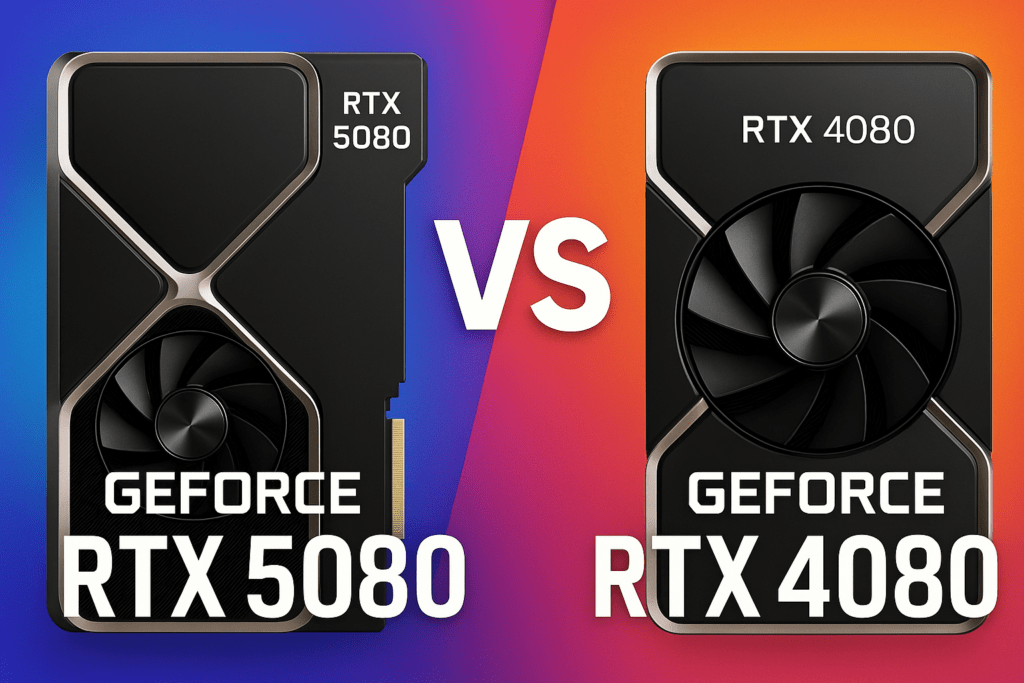
GeForce RTX 5080 vs RTX 4080 – Complete Comparison for Gamers
The GPU market is getting ready for a major upgrade, and one of the most talked-about graphics cards of 2025 is the GeForce RTX 5080. NVIDIA’s upcoming 50-series lineup is expected to bring a significant jump in raw performance, power efficiency, AI capability, and ray-tracing technology.
But the biggest question gamers are asking is simple:
Should you upgrade from the RTX 4080 to the GeForce RTX 5080?
In this long-form comparison, I’ll break down everything—expected specs, performance leaks, AI features, gaming benchmarks, power consumption, pricing, and whether the GeForce RTX 5080 is truly worth waiting for.
This review is written based on leaks, early industry reports, and NVIDIA’s release pattern—and crafted to give you the most realistic and practical buying guide.
What is the GeForce RTX 5080?
The GeForce RTX 5080 is expected to be NVIDIA’s next high-end GPU, sitting right below the flagship RTX 5090. It will target 4K gamers, creators, streamers, and performance-focused PC builders. Based on the new Blackwell GPU architecture, it’s rumored to deliver massive jumps in both raster and ray-tracing performance.
The card is expected to launch sometime in late 2025, and it will replace the RTX 4080 as NVIDIA’s new mainstream high-performance choice.
GeForce RTX 5080 Specifications
| Feature | GeForce RTX 5080 | RTX 4080 |
|---|---|---|
| Architecture | Blackwell | Ada Lovelace |
| CUDA Cores | 12,000 – 14,000 | 9,728 |
| VRAM | 16–20GB GDDR7 | 16GB GDDR6X |
| Memory Speed | 28–32 Gbps | 22.4 Gbps |
| Power Consumption | 300–350W | 320W |
| Ray Tracing Cores | Gen 4 | Gen 3 |
| AI Tensor Cores | Gen 5 | Gen 4 |
| DLSS Version | DLSS 4.0 Ready | DLSS 3 |
Even with similar power consumption, the new architecture and faster GDDR7 memory will make the GeForce RTX 5080 significantly faster.
Performance Comparison: RTX 5080 vs RTX 4080
Early benchmarks and performance leaks indicate a 35% to 55% improvement for the GeForce RTX 5080 over the RTX 4080 in most scenarios.
Let’s break down performance in different categories.
1. 4K Gaming Performance
The biggest upgrade comes in 4K Ultra gaming, where memory bandwidth and AI frame generation matter the most.
RTX 4080 handles most 4K games at 70–100 FPS
GeForce RTX 5080 expected FPS: 110–150+ FPS
DLSS 4 could push frame rates beyond 200 FPS in certain games
Large open-world titles like Cyberpunk 2077, GTA VI, and Starfield are likely to benefit massively.
Verdict: RTX 5080 is a huge step forward for 4K gaming.
2. Ray Tracing Performance
Ray tracing is NVIDIA’s strongest point, and the new Gen-4 RT cores in the GeForce RTX 5080 will deliver:
40%+ better ray tracing performance
Better global illumination handling
Reduced noise and improved lighting accuracy
Games like Metro Exodus, Alan Wake 2, and Cyberpunk 2077 will run noticeably smoother.
Verdict: Ray tracing is dramatically better on the RTX 5080.
3. AI Performance (DLSS 4, Frame Generation, AI Compute)
This is where the RTX 5080 becomes a future monster.
The card will likely support DLSS 4 with advanced frame generation, giving:
Higher FPS without quality loss
Better latency balancing
AI-powered anti-aliasing improvements
AI workloads (Stable Diffusion, Blender AI, LLM locally) will also run faster.
Verdict: Huge generational improvement.
4. Content Creation & Video Editing
Creators using:
Adobe Premiere Pro
DaVinci Resolve
Blender
Unreal Engine
…will see smoother timelines, faster exports, and better 8K performance.
GDDR7 + New Tensor cores = massive creator boost
Power Consumption & Cooling
Despite being much faster, the GeForce RTX 5080 is rumored to be slightly more efficient thanks to Blackwell technology.
RTX 4080: 320W
RTX 5080 expected: 300–350W
You may still need:
A 750W PSU minimum
Good airflow case
High-quality cooling
But overall, power consumption should be stable, not extreme.
Pricing: RTX 5080 vs RTX 4080
GeForce RTX 5080: $999 – $1199 (Expected)
RTX 4080 launch price: $1199
If NVIDIA keeps pricing similar to the RTX 4080, the RTX 5080 will offer much more value for money.
Verdict: Better performance at similar price = great deal.
Should You Upgrade to the GeForce RTX 5080?
Upgrade If You:
Play AAA titles at 4K Ultra
Want better ray-tracing performance
Want future-proof performance for 3–5 years
Do video editing, 3D work, streaming, or AI workloads
Want DLSS 4 benefits
Don’t Upgrade If You:
Have a 4080 and play at 1080p or 1440p
Don’t require ray tracing
Are on a tight budget
GeForce RTX 5080 vs RTX 4080 — Final Verdict
Based on everything we know:
35% to 55% higher performance
Better ray tracing
DLSS 4 support
More AI capability
More efficient architecture
Better 4K gaming experience
The GeForce RTX 5080 is shaping up to be a massive generational upgrade that will easily outperform the RTX 4080 in almost every area.
If you’re planning a new build or waiting for a 2025 GPU upgrade, the RTX 5080 is absolutely worth it.
Conclusion
The GeForce RTX 5080 is shaping up to be the most balanced and powerful GPU upgrade for 2025. In terms of raw performance, ray tracing, and AI features, it easily outperforms the RTX 4080. If you’re planning a new PC build or want serious 4K performance, the RTX 5080 is worth the wait.
FAQs
1. Is the GeForce RTX 5080 good for 4K gaming?
Yes, the RTX 5080 is expected to be one of the best GPUs for 4K Ultra gaming with stable high FPS.
2. Should I upgrade from RTX 4080 to RTX 5080?
If you play at 4K, use ray tracing, or do content creation—yes, it’s a strong upgrade.
3. What will be the price of the GeForce RTX 5080?
Expect $999 to $1199 based on NVIDIA’s pricing pattern.
4. When will the RTX 5080 release?
Most leaks suggest a late-2025 launch window.
5. Will the RTX 5080 support DLSS 4?
Yes, the new architecture is built to support DLSS 4 and next-gen AI features.
6. How much VRAM will the GeForce RTX 5080 have?
Expected: 16GB to 20GB GDDR7.
7. Is RTX 5080 future-proof?
Definitely for 4–5 years in 4K gaming and AI workloads.
Pingback: Nvidia vs AMD Which Graphics Card Is Best for Gamers in 2025